

Key Takeaways
Equity represents ownership in a company, making shareholders partners in its long-term growth.
Companies issue equity shares to raise capital for expansion, innovation, acquisitions, and business development.
Capital appreciation, dividends, and compounding are the three major drivers of wealth creation through equity.
Equity offers the potential for higher long-term returns, but investors should also understand the associated market and business risks.
Before investing, always evaluate a company's business model, financial statements, management quality, valuation, competitive advantage, and industry outlook.
Diversification, patience, disciplined investing, and continuous learning help investors manage risks effectively.
Successful equity investing is based on research and long-term thinking rather than speculation or short-term market movements.
Remaining invested in fundamentally strong companies allows investors to harness the power of compounding and long-term business growth.
Equity remains one of the most effective asset classes for long-term wealth creation and inflation-beating returns.
Introduction
Imagine you are given two choices on your first day of earning a salary.
The first option is to keep all your money in a savings account where it earns a fixed return every year. Your money remains safe, but its growth is limited and may struggle to keep pace with inflation over the long term.
The second option is to become a part-owner of successful businesses. As these businesses grow, launch new products, expand into new markets, increase profits, and create value, your investment grows alongside them.
Most people choose the first option because it feels familiar and secure. However, many of the world's wealthiest investors have built their fortunes through the second option—equity investing.
Every day, people use products and services from companies such as banks, automobile manufacturers, technology firms, pharmaceutical companies, FMCG brands, and retail businesses. These companies generate revenue, earn profits, and continue expanding. When you own equity in such companies, you participate in their growth journey rather than simply being a customer.
This is why equity is often regarded as one of the most powerful tools for long-term wealth creation. Although the stock market experiences short-term fluctuations, history has shown that fundamentally strong businesses have the potential to create significant value for patient investors over time.
However, successful equity investing is not about chasing trending stocks or making quick profits. It requires understanding businesses, evaluating financial performance, managing risks, and maintaining a long-term investment mindset.
In this comprehensive guide, we will answer the most important questions every investor should know about equity, including how it works, why companies issue equity, how equity investments generate returns, what risks investors should consider, and why equity remains one of the most preferred asset classes for long-term wealth creation.
Whether you are a beginner taking your first step into the stock market or an experienced investor looking to strengthen your knowledge, this guide will help you understand equity from the ground up.
What is Equity?
Equity is one of the most fundamental concepts in finance and investing. Simply put, equity represents ownership in a company. Whenever an investor purchases equity shares of a company, they become a shareholder and own a small portion of that business.
Many beginners believe they are simply buying a stock whose price moves up and down every day. In reality, purchasing equity means acquiring an ownership stake in a real business. That ownership gives investors the opportunity to benefit from the company's future growth and profitability.
For example, suppose a company has issued one crore equity shares. If you purchase one thousand of those shares, you become one of the company's shareholders. Although your ownership percentage may be small, you still participate in the company's success.
If the company introduces innovative products, expands internationally, improves profitability, or gains market share, its value may increase. As the business grows, investors often become willing to pay higher prices for its shares, resulting in appreciation of your investment.
This ownership structure is what differentiates equity from many other investment options. A fixed deposit or bond makes you a lender, whereas equity makes you an owner.
Another important characteristic of equity is that shareholders generally receive voting rights in major corporate decisions. These may include electing the board of directors, approving mergers, or making important governance decisions. While small retail investors may not individually influence these decisions, collectively shareholders play an important role in corporate governance.
Equity also allows investors to participate in wealth creation over long periods. Instead of earning only fixed returns, shareholders benefit directly from increasing business value. This is one of the primary reasons why equity has historically outperformed many traditional investment options over extended investment horizons.
It is important to understand that equity returns are never guaranteed. Since shareholders own part of the business, they also share the risks associated with the company's performance. If the company performs well, shareholders benefit. If business performance deteriorates, the value of equity investments may decline.
This balance between higher potential returns and higher risk makes equity suitable for investors who are willing to stay invested for the long term and tolerate short-term market volatility.
Understanding this basic concept forms the foundation of successful equity investing.
Why Do Companies Issue Equity?
Every business, regardless of its size, requires capital to operate and grow. Companies need funds to purchase machinery, hire employees, build manufacturing facilities, invest in technology, expand into new markets, develop innovative products, acquire competitors, and strengthen their overall operations.
One way to raise this capital is by borrowing money from banks or issuing debt securities. However, excessive borrowing increases financial obligations because companies must repay the principal amount along with interest, regardless of business performance.
An alternative approach is raising capital through equity.
When companies issue equity shares, they invite investors to become owners of the business. Instead of repaying borrowed money with interest, companies share ownership with investors who contribute capital in exchange for equity shares.
This capital becomes a long-term source of funding that companies can use to pursue growth opportunities without creating additional debt obligations.
For example, imagine a manufacturing company wants to establish a new production facility worth ₹1,000 crore. Rather than borrowing the entire amount from banks, the company may decide to raise a portion of the required funds by issuing equity shares through an Initial Public Offering (IPO) or a Follow-on Public Offering (FPO).
Investors who believe in the company's future purchase these shares, providing the company with the capital it needs for expansion. In return, investors become shareholders and participate in the company's future growth.
Companies also issue equity for several strategic reasons, including:
Expanding manufacturing capacity.
Investing in research and development.
Launching new products or services.
Entering international markets.
Acquiring other businesses.
Reducing existing debt.
Strengthening working capital.
Improving financial flexibility.
For investors, understanding why a company is raising equity is extremely important. Capital raised for productive purposes, such as business expansion or technological advancement, may contribute to future growth. On the other hand, companies raising funds primarily to cover operational losses or repay excessive debt may require closer analysis.
This is why investors carefully study offer documents, annual reports, and management discussions before investing. They evaluate how effectively management plans to utilize the capital raised and whether those investments are likely to generate sustainable long-term returns.
Ultimately, equity creates a partnership between companies and investors. Businesses receive the financial resources needed to grow, while investors receive an opportunity to participate in that growth through ownership.
When companies allocate capital efficiently and execute their business strategies successfully, both the company and its shareholders can benefit significantly over the long term.
How Does Equity Create Long-Term Wealth?
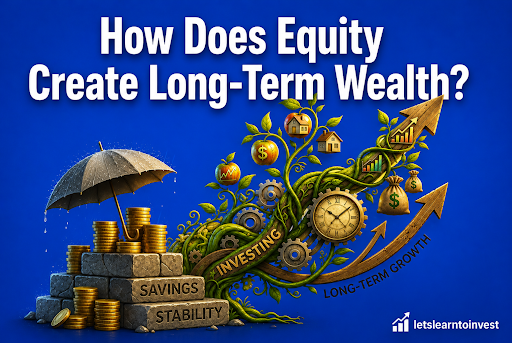
One of the most common questions among new investors is, "How does investing in equity actually make money?" While stock prices move up and down every day, long-term wealth creation through equity is driven by the growth of businesses rather than short-term market fluctuations.
When you invest in equity, you are buying ownership in a company. As the company grows its operations, increases sales, earns higher profits, expands into new markets, launches innovative products, and improves efficiency, the overall value of the business may increase. Since shareholders own a portion of that business, they have the opportunity to benefit from its success.
Equity creates wealth mainly through capital appreciation, dividend income, and the power of compounding.
Capital Appreciation
Capital appreciation refers to the increase in the market value of an investment over time. It is one of the primary ways equity investors generate wealth.
For example, imagine you purchase shares of a fundamentally strong company at ₹500 per share. Over the next ten years, the company consistently increases its revenue, expands into new markets, improves profitability, and gains a larger market share. As investor confidence in the company grows, demand for its shares increases, causing the share price to rise.
If the share price reaches ₹2,500, your investment has increased fivefold without requiring any additional investment from your side. This increase in value is known as capital appreciation.
It is important to understand that share prices do not rise in a straight line. Markets experience periods of optimism and pessimism, economic slowdowns, corrections, and recoveries. However, companies with strong fundamentals often create significant value over long investment horizons.
This is why experienced investors focus more on the quality of the business than on daily price movements.
Dividend Income
Apart from capital appreciation, many companies reward their shareholders by distributing a portion of their profits in the form of dividends.
A dividend is a payment made by a company to its shareholders from its profits. Not every company pays dividends, especially those that prefer to reinvest earnings for future growth. However, many mature and financially stable companies distribute dividends regularly.
Dividend income provides investors with an additional source of return even if they do not sell their shares.
For long-term investors, dividend-paying companies can help generate a steady cash flow while allowing them to continue participating in future business growth.
Many investors choose to reinvest these dividends by purchasing additional shares. This strategy increases the number of shares owned, allowing future returns to be generated on an even larger investment base.
The Power of Compounding
Compounding is often described as one of the most powerful principles in investing. It refers to earning returns not only on your original investment but also on the returns that have already accumulated.
Imagine investing consistently in quality equity investments over several decades. As your investments grow, each year's returns begin generating additional returns in the following years. This creates a snowball effect where wealth grows at an accelerating pace.
The longer an investor remains invested, the greater the impact of compounding.
This is one of the main reasons why financial experts often encourage investors to begin investing early. Starting even a few years earlier can significantly increase long-term wealth because investments receive more time to compound.
Inflation-Beating Returns
Another major advantage of equity investing is its potential to generate returns that exceed inflation.
Inflation gradually reduces the purchasing power of money. While traditional savings instruments may offer stability, their returns sometimes struggle to outpace rising living costs over long periods.
Quality businesses, however, often increase prices, improve productivity, expand operations, and generate higher earnings as the economy grows. As a result, their market value may also increase over time.
By investing in equity, investors gain exposure to businesses that have the potential to grow alongside the economy, making equity one of the most effective tools for preserving and increasing purchasing power over the long term.
Long-Term Perspective Matters
One of the biggest misconceptions about equity investing is that wealth can be created quickly. In reality, sustainable wealth creation usually requires patience.
Stock prices fluctuate daily due to factors such as interest rates, economic data, geopolitical events, company earnings, and investor sentiment. These short-term movements often have little relation to a company's long-term business potential.
Successful investors understand that temporary market volatility is a normal part of investing. Instead of reacting emotionally to every price movement, they remain focused on the company's long-term growth prospects.
History has repeatedly shown that disciplined investors who stay invested in fundamentally strong companies are more likely to benefit from the wealth-creating potential of equity.
Final Thought
Equity is much more than buying and selling shares on a stock exchange. It represents ownership in businesses that drive innovation, generate employment, contribute to economic growth, and create long-term value for shareholders.
While equity investing involves market volatility and business risk, these challenges should not discourage investors from participating in one of the world's most effective wealth-building opportunities. Instead, they highlight the importance of conducting thorough research, understanding company fundamentals, diversifying investments, and maintaining a disciplined investment strategy.
The most successful equity investors are not those who chase every market trend or react to every price movement. They are individuals who understand businesses, invest with conviction, remain patient during periods of uncertainty, and allow time and compounding to work in their favor.
Whether you are beginning your investment journey or strengthening an existing portfolio, understanding the principles of equity investing can help you make informed financial decisions and build sustainable wealth over the long term.
Frequently Asked Questions (FAQs)
1. What is equity in simple words?
Equity means ownership in a company. When you purchase equity shares, you become a shareholder and own a small percentage of that business. As the company grows, you have the opportunity to benefit through rising share prices and dividends.
2. Is equity investing suitable for beginners?
Yes. Beginners can invest in equity provided they first understand the fundamentals of investing, diversify their portfolio, focus on quality companies, and adopt a long-term investment approach instead of trying to make quick profits.
3. How does equity generate returns?
Equity primarily generates returns through capital appreciation, where the share price increases over time, and dividend income, where companies distribute a portion of their profits to shareholders. Reinvesting these returns can further accelerate wealth creation through compounding.
4. What is the difference between equity and debt investments?
Equity represents ownership in a company and offers higher growth potential but comes with greater market risk. Debt investments involve lending money to a company or institution in exchange for fixed interest payments and are generally considered lower-risk investments.
5. How long should I stay invested in equity?
Equity investments are generally more suitable for long-term financial goals. Staying invested for at least five to ten years or longer allows investors to better manage short-term market volatility and benefit from compounding.
Disclaimer
This article is for educational and informational purposes only and should not be considered financial or investment advice. Always conduct your own research or consult a qualified financial advisor before making any investment decisions.


