Key Takeaways
The Government of India is promoting EV adoption through demand incentives, manufacturing support and charging infrastructure.
FAME India was one of the country's major early initiatives for accelerating EV adoption.
PM E-DRIVE is the current major central scheme supporting electric mobility.
The government is also encouraging domestic EV and battery manufacturing through PLI-Auto and PLI-ACC.
EV charging infrastructure is being expanded through dedicated funding and charging guidelines.
Electric buses are receiving significant support to make public transportation cleaner.
GST on EVs and EV chargers has been reduced to 5%, while states have also been encouraged to provide additional benefits such as road-tax concessions.
Introduction: How India Is Moving Towards Electric Mobility
Imagine a city where thousands of two-wheelers, three-wheelers, cars and buses travel every day. Traditionally, most of these vehicles have depended on petrol or diesel. As the number of vehicles increased, so did concerns around fuel consumption, urban air pollution and dependence on imported energy.
This created an important question for India:
How can the country move towards cleaner transportation while also building a strong domestic automobile and battery industry?
The answer has increasingly been electric mobility.
Over the years, the Government of India has introduced several initiatives to encourage people to purchase electric vehicles, support manufacturers, develop batteries, expand charging infrastructure and increase the use of electric public transportation.
The journey did not begin with one single scheme. It developed through multiple programmes, starting with FAME India, followed by manufacturing-focused initiatives such as the PLI schemes, and eventually the PM E-DRIVE Scheme, which is now one of the key central government programmes supporting EV adoption.
So, what exactly has the government done to promote electric vehicles in India?
Let's understand it step by step.
One of India's First Major EV Initiatives

One of the most important steps was the introduction of the Faster Adoption and Manufacturing of (Hybrid &) Electric Vehicles in India (FAME India) Scheme.
The FAME scheme was introduced to encourage faster adoption of electric and hybrid vehicles while supporting the development of the necessary ecosystem.
FAME was implemented in two phases. FAME-I ran from April 2015 to March 2019, while FAME-II operated from April 2019 to March 2024. FAME-II had total budgetary support of ₹11,500 crore and provided demand incentives for electric two-wheelers, three-wheelers and four-wheelers, along with support for electric buses and public charging stations.
The basic idea was simple: make EVs more affordable for consumers and simultaneously build the ecosystem required for adoption.
According to the government, FAME-II supported approximately 16.72 lakh electric vehicles during its implementation period.
PM E-DRIVE: The Current Major EV Promotion Scheme
After FAME-II, the government introduced the PM Electric Drive Revolution in Innovative Vehicle Enhancement (PM E-DRIVE) Scheme.
The scheme was originally approved with an outlay of ₹10,900 crore for two years. Its implementation period has subsequently been extended to 31 March 2028 for most segments, although the incentive window for e-3W L5 closed on 26 December 2025.
PM E-DRIVE focuses on different parts of the EV ecosystem rather than only giving incentives to buyers.
It includes support for eligible electric two-wheelers, three-wheelers, e-trucks and e-ambulances, along with support for electric buses and charging infrastructure. The scheme also includes an e-voucher mechanism through which eligible buyers can receive the applicable demand incentive.
This shows how India's EV policy is gradually moving from simply encouraging EV purchases towards building a broader electric mobility ecosystem.
Supporting Electric Two-Wheelers and Three-Wheelers
Two-wheelers and three-wheelers are particularly important for India's mobility system because they are widely used for personal transportation, last-mile connectivity and commercial activities.
Government incentives have therefore focused significantly on these categories.
Under FAME-II, demand incentives were provided for eligible electric two-wheelers and three-wheelers. PM E-DRIVE has continued support for eligible categories, helping reduce the upfront purchase cost of EVs.
For a consumer, the logic is straightforward:
Lower upfront cost → better affordability → greater possibility of EV adoption.
For commercial three-wheelers, the impact can also extend to operating economics because electric vehicles generally have different energy and maintenance cost structures compared with conventional internal-combustion vehicles.
PLI-Auto: Encouraging EV Manufacturing in India
Promoting EV adoption is not only about encouraging consumers to buy electric vehicles.
India also needs companies capable of manufacturing EVs and their components domestically.
This is where the Production Linked Incentive (PLI) Scheme for Automobile and Auto Components becomes important.
The government approved the PLI-Auto scheme with a budgetary outlay of ₹25,938 crore. The scheme aims to strengthen domestic manufacturing of Advanced Automotive Technology products, including electric vehicles, and encourage investment across the automotive value chain.
The broader objective is to build India as a manufacturing base for advanced automotive technologies.
In simple terms:
The government is not only trying to increase EV sales; it is also trying to increase India's ability to manufacture EVs and important components.
PLI-ACC: Building India's Battery Manufacturing Ecosystem
An EV cannot operate without a battery, making battery manufacturing one of the most important parts of the electric mobility ecosystem.
To encourage domestic battery manufacturing, the government introduced the Production Linked Incentive Scheme for Advanced Chemistry Cell (ACC) Battery Storage.
The scheme has a budgetary outlay of ₹18,100 crore and aims to establish a competitive domestic manufacturing ecosystem for advanced chemistry cells, including large-scale battery manufacturing capacity.
Why is this important?
Because batteries represent a major component of an EV's technology and cost structure.
Developing domestic battery manufacturing can help India:
Build a stronger EV supply chain
Encourage technology development
Attract investment
Reduce dependence on imported battery cells and components
Create manufacturing and employment opportunities
Therefore, battery policy is an important part of India's overall EV strategy.
EV Charging Infrastructure: Solving Range Anxiety
Imagine buying an electric vehicle but worrying:
"What if my battery runs out and I cannot find a charging station?"
This concern is commonly called range anxiety.
The government has therefore placed increasing emphasis on charging infrastructure.
Under FAME-II, ₹912.50 crore was allocated for establishing EV public charging stations. PM E-DRIVE has separately allocated ₹2,000 crore for nationwide EV public charging infrastructure.
The Ministry of Power has also issued the Guidelines for Installation and Operation of Electric Vehicle Charging Infrastructure 2024, covering aspects of charging infrastructure, including charging and battery-swapping facilities. Setting up EV charging stations is also an unlicensed activity, allowing private entrepreneurs to participate.
This is important because EV adoption depends not just on the number of vehicles sold but also on whether users can charge them conveniently.
Promoting Electric Buses and Public Transportation
The government is also focusing on public transportation.
Electric buses can help cities transition towards cleaner public transport while reducing dependence on conventional fuel-powered buses.
Under PM E-DRIVE, ₹4,391 crore has been allocated for the deployment of 14,028 e-buses.
Another important programme is the PM-eBus Sewa-Payment Security Mechanism Scheme, which is designed to support the deployment of electric buses and address payment-security concerns for operators.
The government's approach here is different from private vehicle adoption.
Instead of focusing only on individual consumers, it is using public transportation as another route for increasing electric mobility.
Lower GST on EVs
Another important measure is taxation.
The GST rate on electric vehicles was reduced to 5%, while GST on EV chargers/charging stations was also reduced to 5%.
Lower taxation can reduce the overall cost of purchasing and operating an EV, although the final on-road price depends on several factors, including the vehicle's price, state-level taxes and other charges.
The Ministry of Road Transport and Highways has also advised states to consider waiving road tax on EVs, giving states an opportunity to provide additional incentives.
This means the final benefits available to an EV buyer can vary depending on the state in which the vehicle is registered.
Green Number Plates and Permit Exemptions
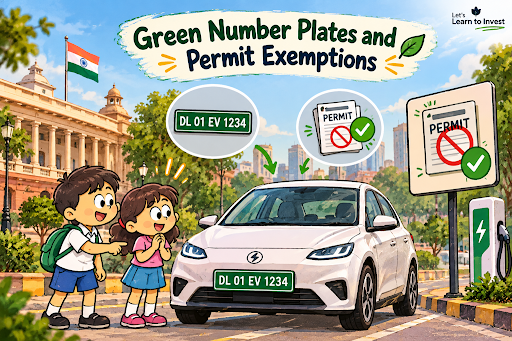
The government has also introduced measures aimed at making EVs easier to identify and use.
Battery-operated vehicles receive green registration plates. The government has also provided exemptions from permit requirements for battery-operated vehicles under the relevant framework.
While these measures may appear small compared with financial incentives, they form part of a broader policy framework designed to make electric mobility more convenient.
Frequently Asked Questions
1. Which government scheme is currently promoting EVs in India?
The PM E-DRIVE Scheme is currently one of the central government's major programmes for promoting electric mobility. It supports eligible EV categories, electric buses, charging infrastructure and other elements of the EV ecosystem.
2. Is FAME-II still active?
No. FAME-II ended on 31 March 2024. It was implemented from April 2019 to March 2024 with an outlay of ₹11,500 crore. PM E-DRIVE subsequently became a major central scheme for EV promotion.
3. Does the government provide subsidies for electric vehicles?
Yes, eligible EV categories can receive demand incentives under government schemes. Under PM E-DRIVE, eligible buyers receive incentives through the scheme's prescribed mechanism, including an e-voucher system.
4. What is PLI-Auto and how does it help EVs?
PLI-Auto is a production-linked incentive programme designed to strengthen domestic manufacturing of advanced automotive technology products, including EVs. Its approved outlay is ₹25,938 crore.
5. Does the government support EV battery manufacturing?
Yes. The PLI Scheme for Advanced Chemistry Cell Battery Storage was introduced to establish a domestic advanced battery manufacturing ecosystem, with an outlay of ₹18,100 crore.
6. What is the government doing to increase EV charging stations?
The government has provided financial support for public charging infrastructure through schemes such as FAME-II and PM E-DRIVE. PM E-DRIVE has an allocation of ₹2,000 crore for EV public charging infrastructure. The Ministry of Power has also issued charging-infrastructure guidelines.
7. Are electric buses also supported by the government?
Yes. PM E-DRIVE includes ₹4,391 crore for the deployment of 14,028 electric buses. Other government programmes also support electric buses for urban and public transportation.
8. What is the government's overall objective for EVs?
The broader objective is to encourage electric mobility while developing a domestic ecosystem covering vehicle manufacturing, batteries, components, charging infrastructure and public transportation. The government's initiatives therefore address both the demand and supply sides of the EV industry.
Final Thoughts
India's transition towards electric mobility is not being driven by a single government scheme. It is the result of several initiatives working across different parts of the ecosystem.
FAME helped create early demand for electric vehicles. PM E-DRIVE is now supporting eligible EV categories and infrastructure. PLI-Auto focuses on advanced automotive manufacturing, while PLI-ACC focuses on battery manufacturing. At the same time, charging infrastructure programmes and electric-bus initiatives are helping build the ecosystem around EVs.
The bigger picture is therefore much more than "buy an electric vehicle."
It is about building an entire electric mobility ecosystem in India.
From the consumer buying an electric scooter to a manufacturer producing an EV, from a battery company developing advanced cells to a charging operator installing stations, government policy is increasingly touching almost every part of the EV value chain.
As India's EV market develops, the next phase will depend not only on incentives but also on affordability, battery technology, charging availability, financing, manufacturing capacity and consumer confidence.