

Key Takeaways
Investing regularly is important, but evaluating investments is equally necessary
Performance tracking is about long-term progress, not daily price movements
Returns should always be judged along with risk, inflation, cost, and taxes
A good investment may still be wrong if it doesn’t match your personal goals
Annual performance review helps avoid emotional and impulsive decisions
Proper evaluation improves clarity, confidence, and long-term wealth creation
Is My Money Really Growing?
A Short Conversation on Performance and Tracking Evaluation
One day, my friend Siya met me and shared her concern.
Siya: “I invest regularly. Markets move every day, but I still don’t know if I’m doing well.”
Riya: “That doubt exists because you are investing, but not evaluating your investments.”
Siya paused and asked,
“So, am I doing something wrong? Is not tracking my portfolio the real issue?”
The answer is yes, partly.
Siya is doing the right thing by investing regularly, but without tracking and evaluating her portfolio, she cannot know whether her investments are truly working.
Investing without evaluation is like moving forward without checking the direction.
So, let us understand performance and tracking evaluation step by step.
What is Performance and Tracking Evaluation?
Performance and tracking evaluation means regularly checking whether your investments are moving in the right direction according to your goals. It is not about watching prices daily but about understanding growth, risk, and progress over time.
For example, if you invested ₹10 lakh for retirement and after five years it becomes ₹14 lakh, evaluation helps you understand whether this growth is sufficient, whether the risk taken was appropriate, and whether you are still on track to meet your future needs.
Why is Performance Evaluation Important?
Performance evaluation is important because investments that were suitable earlier may not remain suitable forever. Life situations, goals, and risk tolerance change over time.
For example, a young investor may take high risk, but as retirement approaches, the same level of risk can be harmful. Evaluation ensures that your portfolio changes along with your life and continues to serve your purpose.
Is Checking Portfolio Value Daily a Good Way to Track Performance?
Checking portfolio value daily is not performance tracking; it is price tracking. Daily movements reflect short-term market noise and often create stress and emotional reactions.
For example, a portfolio may fall 2% in a week due to market volatility, but on an annual basis it may still be growing at 12%. True performance tracking focuses on long-term trends rather than daily fluctuations.
What Does Performance Evaluation Actually Include?
Performance evaluation includes understanding returns, risk, comparison with benchmarks, alignment with goals, and impact of costs and taxes.
Looking at only returns gives an incomplete picture. For example, earning 10% return with very high risk may be worse than earning 8% with stability, especially when your goal is near.
How Should Investment Returns Be Measured?
Returns should be measured in a way that shows consistency and real value. Instead of just seeing total profit, investors should look at annual growth and inflation-adjusted returns.
For example, if an investment grows from ₹5 lakh to ₹6.5 lakh in five years, it looks profitable, but if inflation is high, the real increase in purchasing power may be much smaller.
Why Is Risk Evaluation Necessary Along With Returns?
Risk evaluation is necessary because the same return can come with very different levels of stress and uncertainty. Two portfolios may both deliver 12%, but one may fluctuate sharply while the other grows smoothly.
For example, if a portfolio drops 30% during a market fall and the investor panics and sells, the strategy was not suitable regardless of past returns.
How Can an Investor Understand Risk in Simple Terms?
Risk can be understood by observing how much the portfolio falls during bad market phases and how uneven the returns are. Another key aspect is concentration risk.
For example, if a large portion of money is invested in one stock or one sector, any negative event in that area can significantly damage the portfolio
What Is Benchmark Comparison?
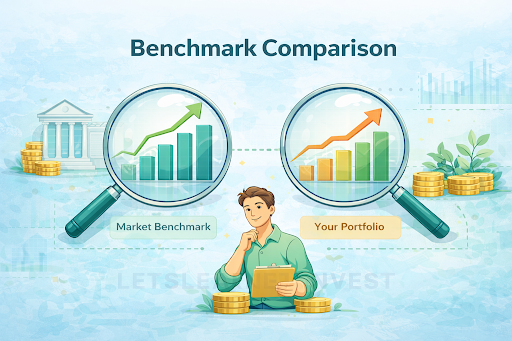
Benchmark comparison means comparing your investment performance with a relevant market standard to understand whether the result was truly good.
For example, if the market index grows by 15% and your portfolio grows by 10%, you may have made money but still underperformed the market. Benchmarks help investors judge performance objectively.
Can a Well-Performing Investment Still Be Wrong for Me?
Yes, an investment can perform well and still be unsuitable for your personal situation.
For example, a highly volatile equity fund may give excellent returns, but if you need money in two years for a house purchase, such volatility can put your plan at risk. The best investment is the one that fits your goal, not the one with the highest return.
How Does Goal-Based Tracking Improve Evaluation?
Goal-based tracking focuses on whether you are progressing toward your financial objectives rather than beating the market.
For example, if your retirement goal requires a certain amount after 20 years, tracking helps you see whether your current savings and returns are sufficient, even if markets are temporarily down.
How Often Should Performance Be Reviewed?
Performance should be reviewed at reasonable intervals, ideally once a year. Daily or monthly reviews often lead to unnecessary worry and poor decisions.
For example, an annual review allows enough time for market movements to settle and gives a clearer picture of whether the strategy is working.
Why Is Asset Allocation Important in Performance Tracking?
Asset allocation explains how your money is divided between equity, debt, and other assets. Over time, market movements can disturb this balance.
For example, strong equity returns may increase risk beyond your comfort level, making rebalancing necessary to maintain stability.
What Is Performance Attribution?
Performance attribution helps identify the reason behind portfolio returns. It explains whether gains came from asset allocation, investment selection, or overall market movement.
For example, if returns came mainly because the stock market rose, future performance may differ if markets slow down.
How Do Costs Affect Long-Term Performance?
Costs reduce returns silently but significantly over time. Even small differences in annual expenses can create a large gap in long-term wealth.
For example, paying 1% extra cost every year may reduce your final corpus substantially over 20 years due to compounding.
Why Should Taxes Be Included in Performance Evaluation?
The true return on investment is what remains after paying taxes. Ignoring tax impact can make performance look better than it actually is.
For example, two investments may show similar returns, but the one with lower tax liability leaves more money in your hands.
What Common Mistakes Do Investors Make While Tracking Performance?
Investors often focus only on returns, react to short-term losses, and compare their portfolio with inappropriate benchmarks.
For example, exiting a long-term investment after one bad year often destroys future gains that require patience to materialize.
How Do Emotions Influence Performance Evaluation?
Emotions like fear and greed distort judgment. Investors tend to sell during market falls and buy after rallies.
For example, panic-selling during a crash converts temporary losses into permanent ones. Structured evaluation helps keep emotions under control.
Is Underperformance Always a Bad Sign?

Underperformance is not always negative. Sometimes it reflects lower risk or defensive positioning.
For example, a conservative portfolio may not rise sharply in bull markets but also protects capital during downturns, which may be ideal for certain goals.
When Should Changes Be Made to a Portfolio?
Portfolio changes should be made when goals, risk tolerance, or financial circumstances change, not due to temporary market movements.
For example, reacting to daily news often leads to unnecessary transactions and poor long-term outcomes.
How Does Rebalancing Support Performance Evaluation?
Rebalancing restores the original asset mix and controls risk.
For example, after a strong equity rally, selling some equity and reallocating to debt helps maintain balance and prevents excessive risk exposure.
What Tools Can Help in Performance Tracking?
Simple tools such as annual statements, goal trackers, and performance summaries are sufficient for most investors.
These tools are effective only when used to make thoughtful decisions rather than emotional reactions.
How Should Beginners Approach Performance Tracking?
Beginners should keep performance tracking simple by reviewing annually, comparing with one relevant benchmark, and focusing on goal progress.
Complexity can be added gradually as understanding improves.
How Does Performance Evaluation Improve With Experience?
With experience, investors focus less on short-term returns and more on following a disciplined process.
For example, consistently investing and reviewing calmly over many years often produces better results than chasing quick gains.
Does Performance Evaluation Improve Long-Term Wealth?
Yes, performance evaluation helps avoid costly mistakes, emotional decisions, and unnecessary changes.
It does not promise extraordinary returns but ensures steady and sustainable wealth creation.
Frequently Asked Questions (FAQ)
1. What is performance and tracking evaluation in simple words?
It means checking whether your investments are growing properly, taking the right amount of risk, and helping you achieve your financial goals.
2. How often should I track my investment performance?
Ideally once a year. Daily or monthly tracking creates stress and leads to poor decisions.
3. Is daily portfolio checking harmful?
Yes, because it focuses on short-term price movement rather than long-term growth and can trigger emotional reactions.
4. Why is risk important while evaluating performance?
Because the same return can come with different stress levels. High risk may look attractive but can damage goals if markets fall sharply.
5. What is benchmark comparison?
It is comparing your portfolio return with a relevant market index to judge whether performance is actually good or just market-driven.
6. Can an investment perform well but still be unsuitable?
Yes. If it doesn’t match your goal timeline or risk tolerance, even high returns can be harmful.
7. Does performance evaluation really improve wealth?
Yes. It reduces mistakes, controls emotions, and helps maintain a disciplined investing approach over time.
Final Thought
Performance and tracking evaluation is not about beating the market every year.
It is about understanding where your money stands, why it behaves the way it does, and whether it is moving you closer to your goals.
When you evaluate regularly:
You panic less
You react less
You invest with confidence
Money grows best when decisions are calm, informed, and disciplined.